
About the Domasław Cemetery
.

The Domasław cemetery is a major cremation necropolis in Lower Silesia that documents how communities organised death, space, and memory from the Bronze Age into the Hallstatt period. This overview presents its setting, development, and significance as a key reference point for our wider Domasław project.
Table of Contents
Location & setting
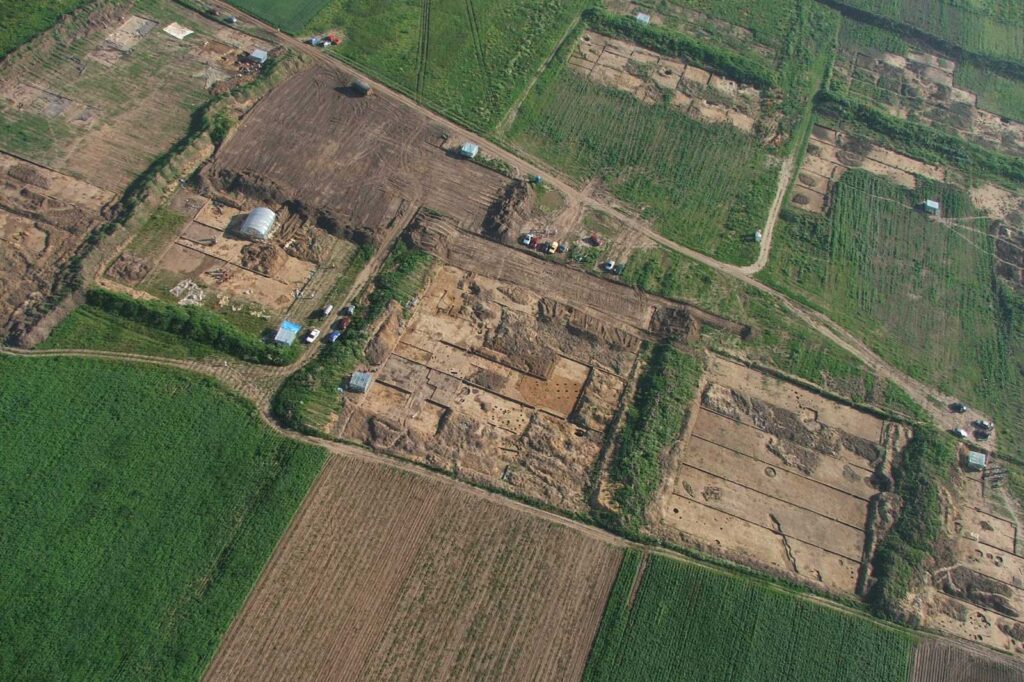
The Domasław cemetery lies in the village of Domasław (Kobierzyce, Wrocław district, Lower Silesia, SW Poland), ~20 km southwest of Wrocław. It occupies a low, post-glacial rise on the Wrocław Plain, between the Ślęza and Bystrzyca catchments. Subtle dry valleys to the northeast shaped visibility and helped structure burial zones, while wetter ground to the south formed a natural limit. The necropolis was established in the west and expanded eastwards over time. Within the site, rectangular grave pits keep a consistent NW–SE axis from the outset—an orientation maintained across later phases. The Domasław cemetery belongs to a wider settlement micro-region with good soils and easy overland routes; Mt Ślęża anchors the regional horizon.
Research history & scale
First explored in 1929 (20 graves), the Domasław cemetery was excavated on a large scale in 2006–2008 during A4 motorway works (IAE PAS, Wrocław & Kraków). Across ~3 ha archaeologists recorded >2,500 features, including more than two thousand graves and some four hundred ceramic deposits (symbolic/secondary). A northern strip remained unexcavated, so the cemetery likely extends further.
Chronological outline
The sequence at the Domasław cemetery begins in the Late Bronze Age (Period III, c. 1300/1250 BC, with roots around 1350–1300 BC). The earliest burials cluster in the southwestern sector in compact rows, many probably marked by mounds. Wide, clean circles in the plan—seven to sixteen metres across—reveal the footprint of barrows. Pits are large and rectangular; a notable share holds hollowed logs or “coffins”. Stones serve as lids, linings and deliberate markers, sometimes repurposed quern stones. The pottery repertoire is the crisp Urnfield “knob-style”: sharply profiled vases, spherical cups with cylindrical or conical necks, jugs (including miniatures) and taut-rimmed bowls. Cremation is the only rite. Most graves are urned, some are unurned or mixed, and multiple-individual deposits occur; burnt animal bone accompanies a minority of Bronze Age burials. Already in this early phase, high-status signatures are present—selected graves show exceptional investment in architecture and surface signalling and include curated sets of objects.
Through Periods IV–V (HA2–HB3), the Domasław cemetery intensifies and extends eastwards into dense central and north-eastern belts. Pits become smaller and more standardised, with wooden chests of laths or half-logs appearing in roughly a sixth of the graves. Stones remain a constant idiom—loose in fills, aligned along walls or capping urns—and annular empty zones still occur, though less often, suggesting a pared-back barrow tradition. Pottery-only deposits multiply around graves. Ceramics shift toward graphitised surfaces with expanded decorative fields and more complex motifs. Within this horizon falls the celebrated grave B50 (HaB) with its concentration of glass beads and metalwork—spectacular proof of long-distance ties. By the end of the Bronze Age, Domasław had become a mature Urnfield cemetery—ordered, crowded, and legible on the surface.
There is no chronological break between the Bronze and Early Iron Age horizons at the Domasław cemetery. Instead, the site plan shows a spatial hiatus zone—a long-standing marshy belt—that separates Bronze Age fields from Hallstatt-period fields. During the Early Iron Age (Hallstatt HC–early HD1, into the mid-6th c. BC), burials are concentrated in the eastern and southeastern regions. Purpose-built wooden chambers become the dominant internal architecture: rectilinear boxes set within oval or circular pits (typically 2–5 m², locally deeper than 1 m). Stones recur as lids, linings and cobbled skirts, while posts and light structures continue the long tradition of marking graves above ground. Around selected chambers, circular ditched enclosures multiply (ditches around about twenty-six chambers; c. twenty-nine funerary circles in total)—the largest such cluster north of the Carpathians and Sudetes. Superpositions remain rare; graves keep their distance, implying persistent surface marking.
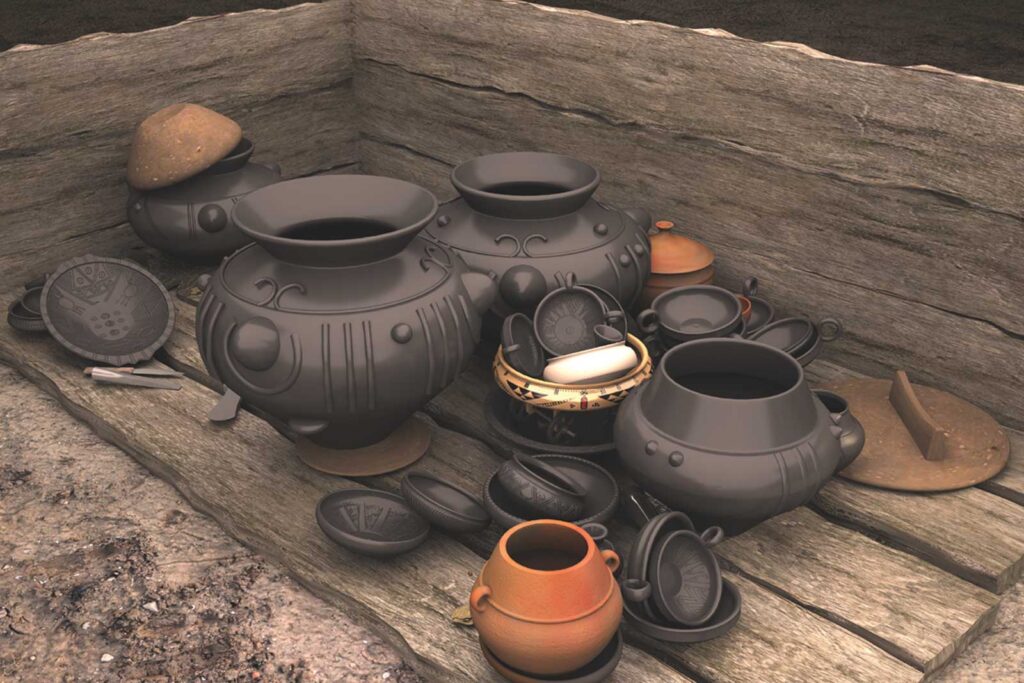
Ceramics trace the clearest line of Hallstatt influence at the Domasław cemetery: conical-neck vases with funnel rims, flanged-rim bowls, and fine cups enter the repertoire, while painted decoration rises alongside graphitised and finely burnished finishes. Inside many chambers the vessels are arranged as deliberate banqueting sets—paired large vases and stacks of cups and scoops in multiples (3–6–9–12) with lidded pots, often focused to the east—so the grave reads as a staged feast. Additional cups, shallow cups and bowls point to serving and pouring during funerary ceremonies. Cremation never gives way: Domasław adopts Hallstatt styles selectively, on local terms. Urns—often vases capped with bowls—are frequently set in the western parts of chambers. Animal bones appear more often than before—mostly in urns, as pyre debris—consistent with formalised food offerings. Pottery deposits (including urns) placed in pit ceilings or beside graves are likewise intentional, likely offerings added during or after burial—practices seeded late in the Bronze Age and more common in the Hallstatt horizon.
Iron tools and weapons appear but coexist with high-status bronzework in the Domasław cemetery assemblages. Swords and spearheads occur; large ribbed bronze bowls accompany some weapon burials, sketching the well-known Central European “weapon-plus-drinkware” pairing within a cremation-only tradition. Elsewhere, horse gear and toiletry kits, harp-shaped fibulae, swan-neck and profiled pins, and bracelets with stamped ends, as well as disc plates and moon idols, build an elite vocabulary that Domasław makes its own. A ceramic cult wagon, zoomorphic rhyta, and funnel vessels add a theatrical register to the funerary script.
In this sense, Hallstattisation at the Domasław cemetery means selective localisation rather than replacement: new forms—funnel-rim vases, flanged bowls and fine cups with a rise in painting—combine with new assemblage grammars (banquet sets, weaponry paired with drinkware), new architectures (rectangular chambers, circular ditches, post settings) and new materials (iron alongside prestigious bronze). Together, these elements heighten visibility and the messaging of rank and plug the community into supra-regional networks that linked Silesia to the Hallstatt world; elite graves are already a steady minority in the Bronze Age and intensify with this Hallstatt ideology.
Across all phases, the cemetery’s growth is legible in plan: it begins in the southwest under mounds, thickens through the centre and northeast as the Bronze Age advances, then concentrates in the east and southeast with chamber-rich Hallstatt fields, while the hiatus belt persists as a long-term boundary. The result is a place navigated by memory—axes held steady, pathways known, graves meant to be seen—with a recurrent funerary choreography that the community performed and refined over generations.
Significance of the Domasław Cemetery
The Domasław cemetery offers a rare, high-resolution record of how a Lower Silesian community organised space, marked graves above ground, and choreographed cremation as a social statement across centuries. The sequence ties Urnfield culture’s origins to the Hallstatt world, tracing change not only in artefacts but also in architecture, surface signalling, and banqueting sets. It shows how imported ideas were selected, recomposed, and displayed without breaking a deep local tradition of cremation. In this long, internally varied sequence, architecture, objects, and funerary landscape speak together, giving a phase-by-phase picture of continuity and transformation—and clarifying how elites communicated status on the northern edge of the Hallstatt world. For our project, the Domasław cemetery is a reference point: a stratified laboratory for reading mobility, identity, and hierarchy in prehistoric Silesia.